
Yamaha XTZ690 T700 World raid
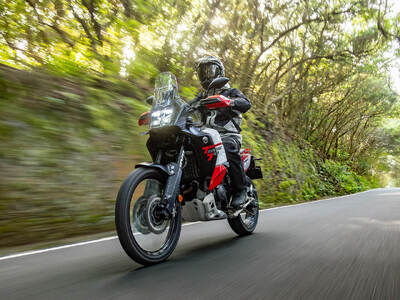
Yamaha Ténéré 700 World Raid
We stripped, measured and tested the suspension on the Yamaha Ténéré 700 World Raid. The World Raid is a significant step up from the standard Ténéré in suspension specification, with fully adjustable KYB forks, a piggyback-reservoir rear shock and long suspension travel.
The basic setup works well, particularly at the rear, but our testing found some clear opportunities for improvement. The front forks are the biggest area of interest, with low-speed damping and limited compression adjustment holding them back. At the rear, spring selection becomes increasingly important as rider weight, luggage and passenger load increase.
The World Raid is a tall motorcycle, with an 880 mm seat height, 180 mm of measured ground clearance and a long-travel chassis. That combination gives it the clearance and suspension movement needed for serious adventure riding, but it also makes correct suspension setup particularly important.
The bike uses 43 mm KYB open-cartridge forks with compression, rebound and preload adjustment, while the rear is equipped with a KYB monotube shock with a piggyback gas reservoir and hydraulic preload adjustment.
On the road and off road, the standard suspension is certainly usable. The biggest difference between the World Raid and a properly sorted version comes from getting the damping and spring rates matched to the rider and the way the bike is being used.
Yamaha XTZ690 T700 World raid Forks
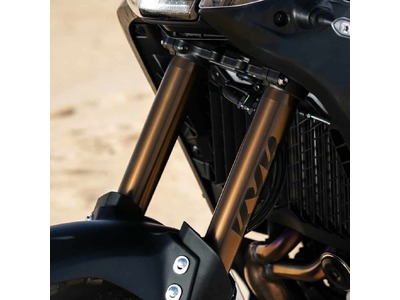
The World Raid uses 43 mm KYB open-cartridge forks with compression, rebound and preload adjustment in both legs. Internally, they use 25 mm damping pistons and 5.7 N/mm fork springs.
They're a noticeable improvement over the suspension fitted to the earlier standard T7. Ride quality is quite good and the rebound damping is already well controlled, but during both ride and dyno testing we found the forks lacking low-speed compression damping.
That shows up as a lack of support rather than outright harshness. Under braking, through rolling terrain and when loading the front of the bike off road, the fork moves more easily than we'd like.
What the dyno showed
Testing on our Rohrig EMA suspension dynamometer confirmed what we were feeling on the bike.
The biggest weakness is the compression adjuster. It produces relatively little change, particularly at lower shaft speeds where chassis control is most noticeable to the rider. The rebound adjuster is considerably more effective and the standard rebound damping itself is already quite good.
That led us away from simply making the whole fork firmer. The goal was to increase support and improve the useful adjustment range without sacrificing the compliance that makes the World Raid comfortable in the first place.
World Raid fork upgrade
Our initial testing added a compression mid-valve to increase low-speed damping while retaining the standard rebound arrangement.
The result was substantially better chassis control without turning the fork into something harsh or overly firm. The front sits up better under load, feels more controlled through repeated terrain and gives the rider a more predictable platform when braking or riding aggressively off road.
We also found one higher-kilometre set of forks where wear to the piston bands had resulted in a significant reduction in damping performance. We've only seen this on one example, so we're not calling it a common World Raid problem, but it is something we will continue to watch as more bikes accumulate kilometres.
For most riders, the standard 5.7 N/mm springs are not the first thing we would change. The damping is where we found the greatest improvement.
Ready to improve the front suspension? View the Yamaha Ténéré 700 World Raid Fork Upgrade Kit
Yamaha XTZ690 T700 World raid Shock
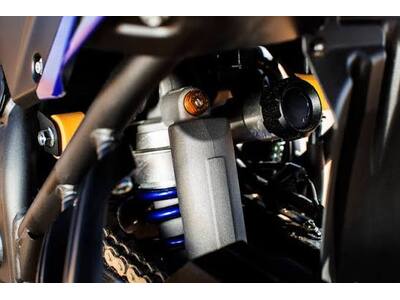
The World Raid shock is a considerable improvement over the shock fitted to the earlier standard T7.
It is a KYB monotube shock with a piggyback bladder reservoir, hydraulic preload adjustment and separate compression and rebound adjustment. Internally it uses the familiar 40 mm KYB damping piston found in a number of Japanese adventure-bike shocks.
In standard form it works quite well. In fact, the rear suspension was one of the areas where we felt Yamaha had made the biggest improvement over the standard T7.
There are still two areas worth addressing: low-speed damping and spring rate.
Shock damping
Dyno testing showed good general damping behaviour and an effective rebound adjuster. As with the forks, however, the stock compression adjuster has very little useful effect.
Our World Raid shock upgrade changes the piston and valving to increase low-speed damping and provide better chassis control.
The difference isn't as dramatic as the improvement available from the forks because the standard World Raid shock is already reasonably good. What the revalve does give you is a more controlled rear end through weight transfer, rolling terrain and repeated hits without simply making the shock stiffer everywhere.
Our World Raid Shock Upgrade Kit uses a billet damping piston with a low-friction piston band, dedicated shim stacks and a modified rebound separator developed specifically around this shock.
Rear spring rate
This is where rider weight matters.
We measured the standard World Raid spring at 6.95 kg/mm, with approximately 16 mm of installed preload. During testing, changing to an 8.0 kg/mm spring produced substantially better sag figures for a 90 kg rider.
As a general starting point we currently recommend:
- Standard: 6.95 kg/mm
- 80 kg rider: 7.5 kg/mm
- 90 kg rider: 8.0 kg/mm
- 100 kg rider: 8.5 kg/mm
Rider weight should include riding gear, and luggage or a regular pillion also needs to be considered.
For a lighter solo rider the standard spring may be perfectly usable. Once rider weight moves towards 100 kg, or the bike regularly carries luggage or a passenger, a spring change becomes much more worthwhile.
What would we change first?
Unlike some adventure bikes, the World Raid doesn't need its suspension completely replaced to work well.
If we were upgrading one in stages, we'd start with the fork damping. That's where our testing found the largest improvement over the standard setup.
At the rear, get the spring rate correct for the rider and load before chasing anything else. The stock shock itself is quite capable, and our revalve is worthwhile for riders looking for more chassis control, but the difference is more subtle than at the front.
For riders wanting to go beyond modifying the standard components, we also have complete replacement suspension options available from TracTive.
The Verdict
The World Raid is more than a standard Ténéré 700 with bigger tanks. Yamaha made meaningful improvements to the suspension, and the rear shock in particular is a significant step forward from the earlier standard T7.
The forks are good in standard form but lack low-speed damping and useful compression adjustment. That's where we found the biggest opportunity for improvement.
At the rear, the standard shock performs well, although the compression adjuster leaves something to be desired. Correct spring selection becomes increasingly important as rider weight, luggage or pillion load increases.
The result is a bike that doesn't need everything thrown away and replaced. Improve the fork damping, spring the rear correctly for the load, and the World Raid becomes a noticeably more controlled and balanced motorcycle while retaining the comfort that makes it such a good adventure bike.
Rebuilding your Ténéré 700 forks? We’ve put together a full breakdown and rebuild tutorial covering the process from start to finish.
Watch the Yamaha Ténéré 700 Fork Breakdown & Rebuild Tutorial on YouTube